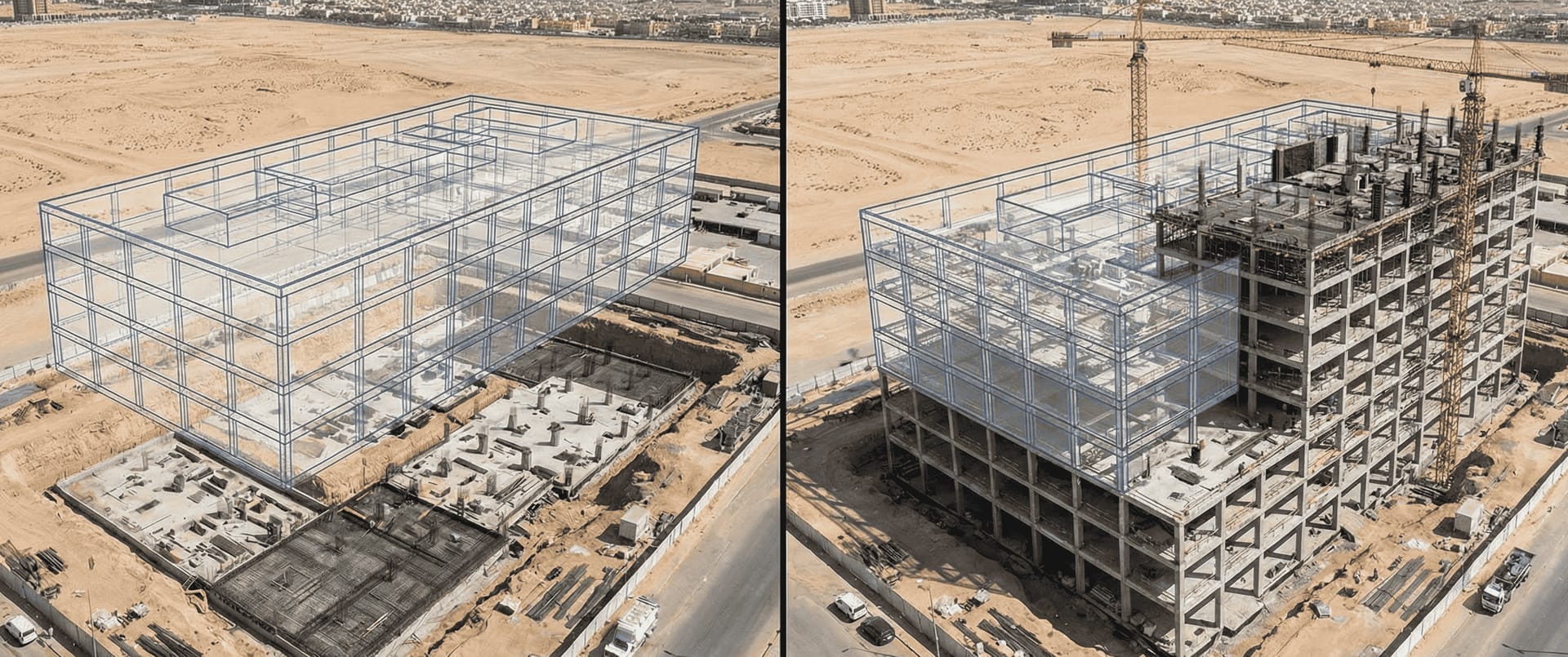
Why this comparison matters in 2026
Until 2022, asset tracking on KSA construction sites meant RFID. Vision AI was reserved for safety. By 2026, three changes have collapsed the gap:
- Hand-tool tracking models are now reliable enough to detect saws, drills and laser levels without tags — see the hand tool tracking piece.
- Re-identification across cameras is solved well enough for yard-wide vehicle and equipment tracking via the equipment tracking solution.
- Edge inference has cut the per-camera cost of running detection 24/7 to a level that competes with RFID infrastructure — see the edge inference glossary.
This guide walks through the head-to-head and the hybrid pattern that wins most procurements.
What “asset tracking” actually means
Three categories dominate KSA construction work:
- Hand tools — saws, drills, levels, laser distance meters. High volume, easily lost, prone to theft.
- Heavy plant — excavators, cranes, telehandlers, generators. Lower count, high value, must be tracked by the day.
- Materials and packages — rebar bundles, modular units, formwork. Moves through the yard in waves.
Each category has a different best-fit technology.
Side-by-side comparison
| Dimension | RFID / BLE / UWB | Vision AI |
|---|---|---|
| Tagging required | Yes, every item | No |
| Sub-metre indoor location | Yes (UWB) | No (typically 0.5–2 m) |
| Outdoor open-yard tracking | Limited (BLE/UWB range) | Strong with multi-camera Re-ID |
| Behaviour analytics | No | Yes (idle time, route, dwell) |
| Zero-light environments | Yes | Limited without IR/thermal |
| Cost per asset (Year 1) | SAR 30–80 per tag + reader infra | None per asset, fixed camera cost |
| Cost per camera-coverage area | N/A | SAR 1,200–3,500 per camera per year |
| Theft deterrence | Reactive (detect missing) | Proactive (record event) |
| Privacy posture | Low (PDPL concerns minimal) | Higher; requires DPO sign-off |
The numbers above match the CCTV AI retrofit cost piece and the hand tool tracking piece [VERIFY-SME for KSA-specific RFID pricing].
Where RFID still wins
Three scenarios where vision is the wrong tool:
- Sub-metre indoor location in a precast yard or warehouse. UWB anchors give 10–30 cm accuracy that vision cannot match.
- Zero-light or smoke-filled environments. Vision degrades; RFID does not.
- Tagged-tool theft prevention at gates. A reader at the gate is cheaper and more reliable than vision Re-ID for known tagged items.
For tagged-tool pricing context see the theft detection solution.
Where vision AI wins outright
Five scenarios where vision is the better answer:
- Untagged assets. Anything that arrives on a flatbed and is gone by sunset is impractical to tag.
- Large machinery on the move. Excavators and cranes are cheaper to track via equipment tracking CV than via UWB anchors at the working face.
- Behaviour analytics. Idle time, productive cycles, route maps require vision.
- Workforce-counting scenarios linked to assets — see workforce counting.
- Multi-purpose installs where the same camera also serves PPE detection, vehicle-pedestrian safety and fall detection.
The hybrid pattern that wins KSA procurements
Most NEOM, Aramco contractor and Diriyah projects in 2026 end up with the same architecture:
- UWB or BLE for high-value sub-metre tracking — typically 200–800 tags per major project.
- Vision AI for site-wide situational awareness — covering yards, gates, working faces.
- A single analytics layer that unifies both feeds — see the AI analytics platform.
- Common dashboard for ops — supervisors see a single view, not two systems.
This pattern wins because it gives the OEM/MMC contractor procurement defence (RFID for high-value items) and the owner full-site visibility (vision for everything else).
Integration realities
The technical hand-off between the two stacks is where projects actually stumble. Three patterns work:
- Common event bus — both systems publish to the same Kafka or MQTT bus with a shared schema.
- Joined dashboard via API — see API access for the integration shape.
- VMS-anchored events — RFID readers and vision events both produce VMS bookmarks via Hikvision, Genetec or Milestone integrations.
Picking one of these in advance saves 4–6 weeks of integration debugging.
Common procurement traps
- The “one technology fits all” RFP — forces both vendors to pretend they cover the other category.
- Counting tags as a CapEx-only line — readers, software and replacement tags are recurring costs.
- Ignoring PDPL on the vision side — every camera that tracks behaviour needs a lawful basis register.
- Skipping the integration spec — write the event schema before signing.
For the broader procurement view see the top 10 platforms shortlist.
Two worked examples
Example A — Aramco contractor lay-down yard. 1,200 tagged hand tools, 18 cameras for site-wide awareness. Year-1 cost: SAR 95,000 RFID + SAR 60,000 vision = SAR 155,000.
Example B — NEOM Trojena precast yard. 400 UWB tags for precast units (sub-metre tracking required), 6 cameras for vehicle and worker safety. Year-1 cost: SAR 220,000 UWB + SAR 22,000 vision = SAR 242,000.
[VERIFY-SME — both ranges reflect 2026 KSA pricing and assume KSA-resident analytics.]
Next steps
If you are scoping asset tracking in 2026, start with the equipment tracking solution, the theft detection solution and the hand tool tracking piece. Cross-reference the edge AI vs server-side processing answer and the CCTV retrofit guide.
Book an asset-tracking scoping call and we will produce a hybrid RFID + vision plan for your specific project within two weeks.