Why this is still a problem in 2026
Three structural factors keep vehicle-pedestrian incidents high in KSA industrial yards:
- Forklift and telehandler density. A typical lay-down yard runs 8–25 powered units across a single shift.
- Visibility limits. Stacked materials create blind corners that drivers and walkers cannot see around.
- Multi-cultural workforce. Workers from different backgrounds have different walking conventions and signage assumptions.
Static walkway paint and audible reverse alarms reduce but do not eliminate the residual risk. Computer vision adds a real-time, context-aware layer — see the vehicle-pedestrian safety solution and the danger zone alerts solution.
Camera placement that actually works
Five rules from 2024–2026 KSA deployments:
- Elevated, wide-angle cameras at intersection points. Mount 5–7 m above ground at each major yard junction. Field of view 90–110°.
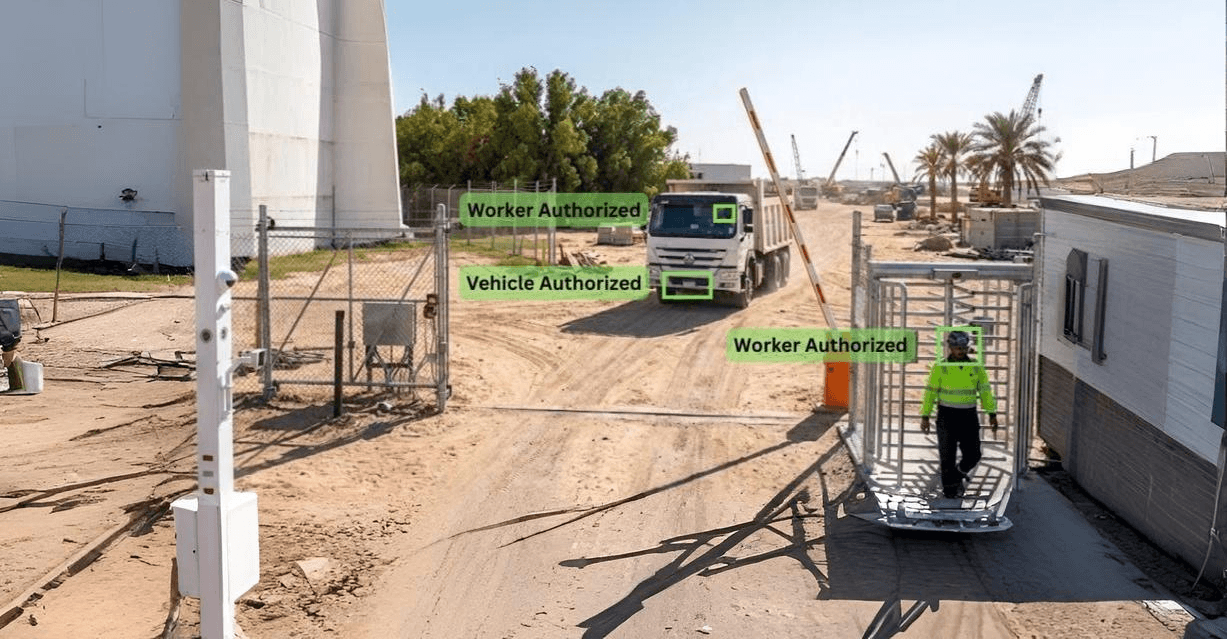
- Pole-mounted cameras at gate-to-yard transitions. The first 15 metres after a gate is high-incident.
- Mast cameras at lay-down corners. Stacked materials create blind zones; a mast camera sees over them.
- Forward-facing cameras on heavy vehicles. Optional but increasingly common; gives in-cab driver assist.
- Avoid pure overhead cameras. They lose pedestrian-vehicle relative speed cues.
The perimeter monitoring solution handles the static-zone definitions; the equipment tracking solution handles vehicle identity.
Near-miss thresholds — what to detect
Three thresholds matter:
- Spatial threshold. A pedestrian within 3 metres of a moving vehicle is a near-miss; within 1.5 metres is an incident-grade event.
- Speed threshold. A vehicle over 6 km/h within 5 metres of a pedestrian is a near-miss; over 10 km/h is incident-grade.
- Time-to-collision (TTC) threshold. Below 2 seconds is the operating threshold for an audible warning.
These thresholds should be tuned per vehicle class. A forklift moving at 10 km/h is more controllable than a 40-tonne articulated vehicle moving at the same speed.
Audible warning latency
The vision pipeline only earns its keep if the audible warning reaches the operator before the collision. A defensible 2026 latency budget:
| Stage | Budget |
|---|---|
| Frame capture to inference | 80–200 ms |
| Inference | 50–150 ms |
| Decision logic | 20–50 ms |
| Audible output | 50–200 ms |
| Total | 200–600 ms |
Anything above 800 ms is too late. Run inference at the edge on Hailo-8 or Jetson Orin NX; cloud round-trips will not meet the budget.
False-positive control
Three controls that bring nuisance alerts to operationally tolerable levels:
- Persistence rule. A near-miss only fires if the spatial-and-speed criteria hold for at least 3 frames at 10 fps.
- Zone gating. Pedestrian walkways and rest areas are excluded from alarm zones.
- Authorised-vehicle suppression. A vehicle whose driver and route are paired with a permitted task does not raise alarms unless TTC drops below the incident threshold.
Without these, supervisors abandon the system within a week. See the hard-hat detection accuracy piece for the analogous PPE controls.
Integration with the yard VMS
The deliverable that wins ops buy-in is a near-miss bookmark inside the existing VMS, not a separate dashboard. Pattern that works:
- Each near-miss produces a JSON event with
event_id,timestamp_utc,camera_id,zone_id,vehicle_class,pedestrian_id,ttc_s,speed_kmh,clip_hash. - Event posts to the VMS as a bookmark — see the Hikvision integration, Hanwha, Genetec, Milestone, Bosch and Axis pages.
- Audible warning fires immediately at the local zone speaker.
- Aggregate near-miss data flows to the AI analytics platform for weekly trend reports.
Trend reporting — what HSE actually wants
Near-miss counts only matter when they are tracked over time. A useful HSE report ships:
- Near-miss rate per 1,000 vehicle-hours by zone.
- Top-five hot spots with corresponding camera bookmarks.
- Compliance status — fraction of incidents where audible warning fired in time.
- Trend over the last 12 weeks with a moving-average smoothing.
This format anchors in the KPI pulse on construction AI ROI in Saudi Arabia.
PDPL posture
Continuous behavioural monitoring inside an industrial yard is a PDPL processing activity. The defensible posture:
- Lawful basis registered for safety monitoring.
- Face-blurring at the edge for non-incident frames.
- Retention 14 days for non-incident clips, 90 days for incident clips, longer if linked to an HSE investigation.
- DPO sign-off, anchored in the PDPL compliance checklist and the data residency posture.
Cost envelope
Indicative 2026 SAR cost for a 50,000 m2 KSA industrial yard:
| Item | SAR per year |
|---|---|
| 12 cameras (existing or new) | 14,000–42,000 retrofit |
| Edge inference server | 35,000–55,000 |
| Audible warning hardware | 18,000–28,000 |
| Software licence | 60,000–110,000 |
| Integration and tuning | 40,000–70,000 (Year 1) |
| Total Year 1 | 170,000–305,000 |
[VERIFY-SME for KSA-specific pricing.] See the CCTV AI retrofit piece for the broader retrofit context.
Common deployment mistakes
- No staged validation set. Without a 50–100 staged near-miss set on the actual yard, vendor accuracy claims are unverifiable.
- Audible warning latency above 800 ms. The system is functionally a CCTV log, not a safety system.
- Skipping the authorised-vehicle list. Every legitimate trip becomes a false alarm.
- No PDPL DPO sign-off.
Next steps
If you are scoping vehicle-pedestrian safety on a Saudi industrial yard, start with the vehicle-pedestrian safety solution, the danger zone alerts solution and the intrusion detection solution. Cross-reference the Aramco EHS compliance guide.
Book a yard-safety scoping call and we will produce a camera placement plan and threshold register within 10 working days.