Why “AI” loses the budget meeting
Construction AI sales decks routinely lead with technology — YOLO, transformers, foundation models — and lose the room. CFOs do not buy detectors. They buy reductions in line items they already track. The five KPIs in this guide are the ones Saudi finance functions are already monitoring; framing AI investment against them turns a speculative pitch into a comparable line item.
For broader programme context see the Vision 2030 digitisation reading and the PPE detection field guide.
KPI 1 — Workplace incident reduction
Why CFOs care
Lost-time incidents drive insurance premiums, contractor scoring with owners, and project delays from regulatory holds. Aramco contractor scoring is particularly sensitive to TRIR.
What computer vision contributes
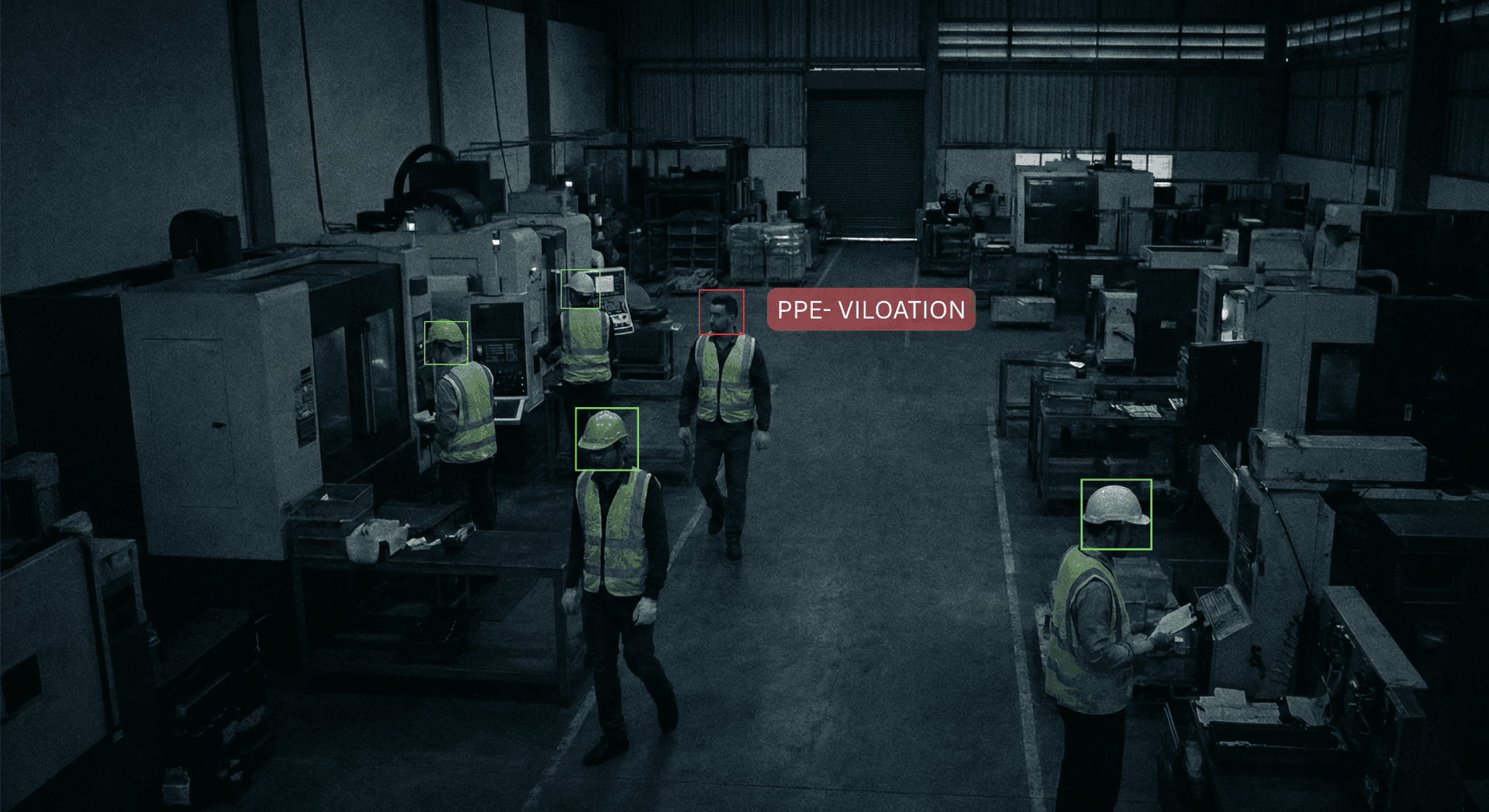
- PPE detection — flags missing hard hat, FRC, harness in real time
- Fall detection — notices a fallen worker even without a manual call
- Danger zone alerts — geofences keep workers out of swing radii
- Vehicle and pedestrian safety — collision risk between mobile plant and workers
How to measure
| Metric | Baseline source | Target |
|---|---|---|
| TRIR per 200,000 hours | Project HSE log, last 12 months | -20% to -50% in year 1 |
| Near-miss reports | HSE log + AI events | +30% reporting (visibility) |
| Permit-to-Work violations | SAP-PM | -40% |
The visibility uplift is counterintuitive but real — AI surfaces near-misses that humans were not catching, so reported numbers go up while severity goes down.
KPI 2 — Defect-escape rate
Why CFOs care
Defects discovered after handover cost 5–20x what they cost to fix during construction. On Vision 2030 megaprojects with handover penalties, the multiplier is even higher.
What computer vision contributes
- Defect detection — visual classification of common defects on concrete, paint, finishes
- Crack detection — measurable crack mapping on structural surfaces
- Concrete quality inspection — pour and cure monitoring with deviation flags
- Punch list automation — AI-generated punch items from walkthroughs
How to measure
- Defect-escape rate: defects found post-handover / total defects found across project
- Rework hours per 1,000 m² delivered
- Defect cost ratio: rework SAR / total contract SAR
CFO-presentable target: a 25–40% reduction in defect-escape rate within the first 12 months on a project that previously relied on visual walkthroughs.
KPI 3 — Schedule slippage delta vs baseline
Why CFOs care
Schedule overruns generate liquidated damages, financing carrying cost, and reputational drag. On Saudi megaprojects, the financing cost alone often dominates direct construction cost.
What computer vision contributes
- Progress tracking — automated weekly progress against BIM
- BIM comparison — design vs as-built deviations
- As-built BIM — recorded reality for downstream contracts
- Drone site survey — weekly cadence of capture
How to measure
| Metric | Baseline | Target |
|---|---|---|
| Schedule Performance Index (SPI) | Primavera baseline | +5–10% sustained |
| Days from issue surface to PMO awareness | Manual report cadence | -10 to -20 days |
| Disputed progress claims | Owner correspondence log | -50% |
The most underappreciated saving is in dispute reduction. Objective progress measurement collapses the negotiation surface in monthly billings.
KPI 4 — Stockpile volumetrics accuracy
Why CFOs care
Earthworks and material stockpiles are large balance-sheet items. Manual surveys are infrequent and prone to dispute. On large infrastructure jobs (Riyadh metro, Trojena terrain works) volumetric disputes frequently exceed seven figures.
What computer vision contributes
- 3D site mapping — drone photogrammetry for volumetric calculation
- Material tracking — flow tracking from stockpile to placement
- Drone site survey — cadence and accuracy class
How to measure
- Volumetric accuracy: AI-derived volume vs ground-truth survey, expressed as % deviation
- Survey frequency: cycles per month
- Reconciliation lag: days from physical state to accepted volumetric
Public-data accuracy class for drone photogrammetry on suitable terrain sits at 1–3 cm with ground control points. See the 3D site mapping reading for context.
KPI 5 — RFI response time
Why CFOs care
A Request for Information (RFI) that sits open for two weeks delays a work front. On a megaproject with 20+ open work fronts at any time, RFI lag aggregates into schedule risk and financing cost.
What computer vision contributes
This KPI is less obvious for AI vision, but the connection is real:
- AI-detected deviations auto-create RFI drafts with embedded evidence
- BIM comparison provides geometric proof, removing rounds of clarification
- Smart monitoring platform routes RFIs to the right discipline owner automatically
How to measure
| Metric | Baseline | Target |
|---|---|---|
| Mean time to RFI close | Document control log | -30 to -50% |
| RFIs closed without re-issue | Document control log | +20% |
| Disciplines hit on first routing | Document control log | +30% |
Putting the five KPIs into a 2026 ROI deck
A 12-page deck is enough. Slide-level outline:
- Executive summary — investment ask, 36-month NPV, payback
- Five KPIs and the current baseline
- The four AI capabilities you will deploy and which KPIs they move
- Site and timeline scope
- Edge vs cloud architecture (link to the CCTV vs edge AI decision tree)
- PDPL and data residency posture (link to the PDPL checklist)
- Vendor: IKTVA score, Saudi-Made status (link to the IKTVA reality check)
- Implementation phasing
- Risks and mitigations
- Year-1 measurement plan tied to KPIs 1–5
- Year-2 expansion options
- Approvals and next steps
This ordering survives most Saudi CFO reviews because it answers the three questions a finance lead asks first: what is the cash impact, what is the regulatory posture, and what is the local-content posture.
Common ROI traps
Three mistakes appear in nearly every rejected business case:
- Single-KPI cases. A safety-only deck loses to a programme-wide deck nine times out of ten because megaproject CFOs run portfolio decisions, not point investments.
- Productivity guesses. “Workers are 15% more productive” is unverifiable. It will be cut during scrutiny. Stick to the five measured KPIs.
- Ignoring data residency. A great ROI case can fail on PDPL grounds if the data path runs through non-resident clouds. Resolve it on slide six, not in week 12.
Next steps
If you are building a Saudi 2026 construction-AI business case, start with the solution catalogue, the progress tracking workflow, and the 3D site mapping reading. For procurement scoring see the IKTVA guide.
Request a 5-KPI baseline assessment for your project and we will deliver a CFO-ready deck within 15 working days.